

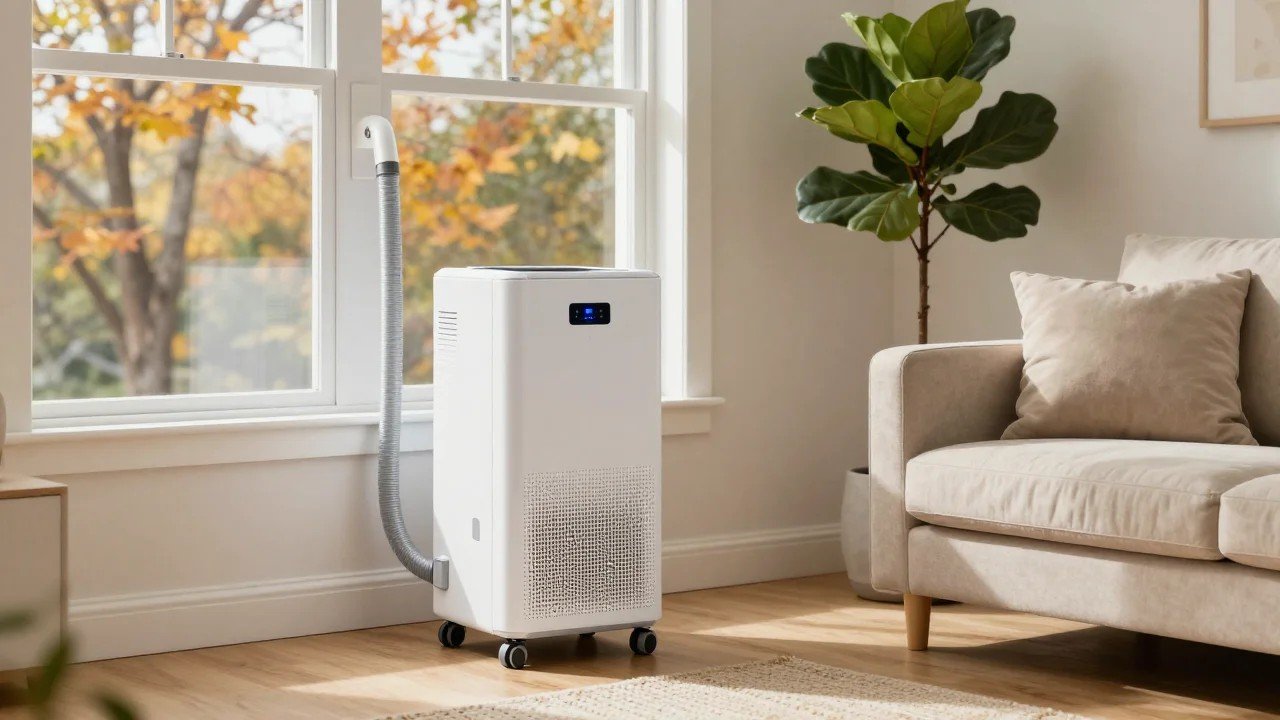
Affiliate disclosure: SmartHomeGen earns a commission from qualifying Amazon purchases made through links on this page, at no extra cost to you. Portable AC prices swing a lot between summer and fall, so always check the current price on Amazon before you buy.
Short answer: the Midea Duo is the best portable air conditioner for most American homes in 2026. Its hose-in-hose (dual-hose) design and inverter compressor give it 12,000 BTU of real-world cooling under the Department of Energy’s SACC test, which is about as much as any standard portable AC delivers, and it runs quieter and more efficiently than most rivals. Get the Midea Duo with heat (MAP14HS1TBL) if you also want a heat pump for chilly spring and fall days. Pick the Whynter ARC-1230WN for a big or sun-heavy room, the LG LP1419IVSM if easy setup and app control matter more than raw power, and the GrowthWing 14,000 BTU if you want Wi-Fi control and auto-evaporation in one large room and you’re comfortable with a newer Amazon brand.
We’re publishing this in October on purpose. Fall is when portable AC prices often drop as stores clear summer stock, and it’s when people start asking whether a portable unit that also heats is worth it. Our GrowthWing portable air conditioner review has also become one of the most-searched pages on this site, and readers keep asking the same thing: is GrowthWing a good brand, and how does it compare with Midea, Whynter and LG? This guide answers that and the other questions people actually type into Google before buying.
Our Quick Picks
- Best overall: Midea Duo (MAP14S1TBL). Dual-hose, inverter, 12,000 BTU SACC, Wi-Fi. Check current price
- Best with heat: Midea Duo with heat pump (MAP14HS1TBL). The same cooling, plus heating that works down to about 41°F outdoors. Check current price
- Best for large rooms: Whynter ARC-1230WN. Dual-hose, 12,000 BTU SACC, and a top performer in independent cooling tests. Check current price
- Easiest setup and smart control: LG LP1419IVSM. Single hose, dual inverter, LG ThinQ app. Check current price
- Smart pick with auto-evaporation: GrowthWing 14,000 BTU (HAC904WF). Wi-Fi, voice control, and up to 72 hours without draining. Check current price
- Small bedrooms and dorms: an 8,000 BTU-class single-hose unit from a mainstream brand. Check current price
First, the Number That Actually Matters: SACC vs. ASHRAE BTU
Almost every portable AC box says “14,000 BTU” in big type. That number usually comes from the older ASHRAE test, which ignores two things that make portable units weaker in real life: heat from the exhaust hose and the machine itself, and warm outdoor air that gets pulled into the room to replace the air a single-hose unit blows outside. Since 2017, the U.S. Department of Energy has required a second, more realistic rating called SACC (Seasonally Adjusted Cooling Capacity).
The gap between the two numbers tells you a lot. In independent testing by Consumer Analysis and others, the Midea Duo and Whynter ARC-1230WN keep 12,000 of their 14,000 advertised BTU (about 86%). The LG LP1419IVSM keeps 10,000 (about 71%), and the older Whynter ARC-14S keeps 9,500 (about 68%). Those differences show up as faster cooling and lower room temperatures in testing. Always compare SACC to SACC. If a brand doesn’t publish a SACC number at all, assume real-world cooling is meaningfully below the big number on the box.
Comparison Table
| Model | Box rating (ASHRAE) | Real cooling (DOE SACC) | Hose | Heat | Smart control | Best for | Price |
|---|---|---|---|---|---|---|---|
| Midea Duo MAP14S1TBL | 14,000 BTU | 12,000 BTU | Dual (hose-in-hose) | No | Wi-Fi app, voice | Most homes, up to ~550 sq. ft. | Check current price |
| Midea Duo MAP14HS1TBL | 14,000 BTU | 12,000 BTU | Dual (hose-in-hose) | Yes, heat pump (41–86°F outdoors) | Wi-Fi app, voice | Year-round room comfort | Check current price |
| Whynter ARC-1230WN | 14,000 BTU | 12,000 BTU | Dual | No | Check listing | Large or sunny rooms | Check current price |
| LG LP1419IVSM | 14,000 BTU | 10,000 BTU | Single | No | LG ThinQ app, voice | Easy install, quiet bedrooms | Check current price |
| GrowthWing HAC904WF | 14,000 BTU | Not published | Not stated | No | Wi-Fi app, Alexa/Google (per owners) | One large room, less draining | Check current price |
| Whynter ARC-14S | 14,000 BTU | 9,500 BTU | Dual | No | No | Only at a deep discount | Check current price |
Ratings are from manufacturer listings and published independent tests. Check the Amazon listing for the exact model number before you buy, because sizes and versions are often sold on the same page.
The Best Portable Air Conditioners, Reviewed
1. Midea Duo (MAP14S1TBL): Best Overall
The Midea Duo is the portable AC that independent reviewers keep putting at the top, including Consumer Analysis, Forbes Vetted and Wirecutter. Its trick is a single wide hose with two channels inside: one pulls outdoor air in to cool the machine’s condenser and the other pushes hot air back out. You get the efficiency of a dual-hose unit with the simpler look and setup of one hose. Pair that with a variable-speed inverter compressor and you get strong cooling (12,000 BTU SACC), smooth temperature control instead of loud on-off cycling, and low power draw for its size. Midea rates it for rooms up to about 550 sq. ft. and quotes noise as low as 42 dBA.
Who it’s for: anyone cooling a living room, large bedroom or home office who can’t use a window AC. Watch out for: it’s heavy (over 70 lb), the hose is bulky, and the warranty is one year. Check current price
2. Midea Duo with Heat (MAP14HS1TBL): Best for Fall and Spring
This is the same cooling machine with a reversible heat pump. In heat mode it pulls warmth from outdoor air and moves it inside, which is far more efficient than a resistance heater, but it has limits. Midea’s manual lists heat-pump operation for outdoor temperatures from about 41°F to 86°F, and output falls as it gets colder outside. You also have to connect the included drain hose the whole time heat mode runs, so you need a floor drain, a bucket spot or a hose route nearby.
Who it’s for: a sunroom, converted garage, upstairs bedroom or apartment that gets chilly in October before the building heat comes on. Not for: replacing your furnace in January. For real winter warmth in one room, see our best space heater guide. Check current price
3. Whynter ARC-1230WN: Best for Large Rooms
The Whynter ARC-1230WN matches the Midea’s 12,000 BTU SACC rating with a true two-hose design, and it cooled about as fast as the Midea in Consumer Analysis’s test room. Whynter rates it for rooms up to about 600 sq. ft., which makes it a strong choice for open-plan spaces, sun-heavy upstairs rooms or a bonus room over a garage. The main downside is installation: its window kit comes in fewer pieces than the Midea’s, so you may have to cut a panel to fit your window.
Who it’s for: big, hot rooms where you want maximum cooling and don’t mind a slightly fussier install. Check current price
4. LG LP1419IVSM: Easiest Setup and Best App
LG’s dual-inverter portable AC uses a single hose, so its SACC rating is lower at 10,000 BTU. In return you get a simpler install, quiet operation thanks to the inverter compressor, and LG’s ThinQ app with Alexa and Google Assistant support. It’s a good match for a bedroom or office around 300 to 450 sq. ft. where you care more about noise and convenience than squeezing out every last degree.
Who it’s for: renters and smart-home users who want an AC that’s easy to put in and control from a phone. Check current price
5. GrowthWing 14,000 BTU (HAC904WF): Smart Pick with Auto-Evaporation
GrowthWing’s 14,000 BTU unit is a 3-in-1 (cool, dehumidify, fan) smart portable AC with app and voice control, a remote, a 42 dB Sleep Mode claim, and an auto-evaporation system that GrowthWing says can run up to 72 hours without draining in most conditions. The window kit fits sliding windows from about 20 to 67 inches. Owner reviews describe it cooling a roughly 300 sq. ft. attic bedroom and a large master bedroom well.
The catch is transparency. GrowthWing doesn’t publish a DOE SACC rating or say whether it’s single- or dual-hose, so its “up to 700 sq. ft.” claim is based on the optimistic ASHRAE number. Plan on one large room. It weighs 66 lb, has no heat mode, and carries a 1-year warranty. Our full GrowthWing 14,000 BTU review covers specs, noise reports and setup in detail. Check current price
6. Small Bedrooms, Dorms and Home Offices
For a room under about 250 sq. ft., an 8,000 BTU-class single-hose unit from a mainstream brand is often enough and is lighter and cheaper to run. Compare the SACC number on the box, not the headline BTU, and check the noise rating if it will sit next to a bed. Check current price
Skip Unless It’s Deeply Discounted: Whynter ARC-14S
The ARC-14S still shows up in a lot of older “best of” lists. It has two hoses, but its older fixed-speed compressor gives it only 9,500 BTU SACC, so newer inverter models cool better for similar money. Check current price
How to Choose a Portable Air Conditioner
Size it by SACC and room area
ENERGY STAR’s room AC sizing chart is a good starting point. Use it with the SACC number:
| Room size | Cooling needed |
|---|---|
| 150–250 sq. ft. | about 6,000 BTU |
| 250–350 sq. ft. | 7,000–8,000 BTU |
| 350–450 sq. ft. | 9,000–10,000 BTU |
| 450–550 sq. ft. | about 12,000 BTU |
Add about 10% for a very sunny room, take off about 10% for a heavily shaded one, add about 600 BTU for each regular occupant beyond two, and add about 4,000 BTU if the unit cools a kitchen.
Dual hose beats single hose
A single-hose unit blows room air outside, which creates negative pressure and pulls warm air in through doors and gaps. A dual-hose or hose-in-hose design uses outdoor air to cool itself, so it wastes less of the air you already paid to cool. That’s the main reason the top three picks here outperform the rest.
Inverter compressors are worth it
An inverter compressor speeds up and slows down instead of slamming on and off. That means steadier temperatures, lower power use and less of the loud “compressor kick-on” that wakes people up at night.
Check the window and drainage before you buy
Measure your window first. Most kits fit sliding and double-hung windows, but casement and crank windows usually need a separate kit or a custom panel. Most modern units re-evaporate condensate through the exhaust, but in humid weather or dehumidify mode you may still need to drain them, and heat-pump models need the drain hose connected whenever they heat.
Smart features
Built-in Wi-Fi lets you schedule cooling before you get home and change settings from bed. Most portable AC manuals say to plug the unit directly into a grounded wall outlet rather than an extension cord or power strip, so pick a model with its own app instead of adding a cheap plug-in timer.
Portable AC vs. Window AC: Which Should You Get?
If your building and window allow it, a window AC or U-shaped window AC usually cools better per dollar and per watt, because the hot side of the machine stays outside. Portable units make sense when your HOA, landlord or window type rules out a window unit, when you want to move cooling between rooms, or when you want a heat-pump model that also warms a room in spring and fall.
FAQ: What People Ask About Portable Air Conditioners
Is GrowthWing a good brand?
GrowthWing is a newer brand sold mainly on Amazon, and the Amazon listing names Rnice as the maker of its 14,000 BTU HAC904WF. Owner reviews are generally positive on cooling a single large room and on the app, while some owners call it loud when the compressor cycles on. It’s a reasonable buy if the features fit you, but it publishes less data than Midea, LG or Whynter (no DOE SACC rating) and has a 1-year warranty. If you want proven, independently tested cooling, the Midea Duo is the safer choice. See our full GrowthWing 14,000 BTU review for the details.
Are GrowthWing portable air conditioner reviews reliable?
Most GrowthWing reviews are owner reviews on Amazon rather than lab tests. Read the recent ones for your exact size (10,000, 12,000 or 14,000 BTU), because some listings mix sizes and spec tables. Before checkout, confirm that the size selector and model number match the unit you want.
What is the best portable air conditioner in 2026?
The Midea Duo (MAP14S1TBL) is the most consistent top pick in independent testing for 2026, with the Whynter ARC-1230WN close behind. Both deliver 12,000 BTU SACC, the most you can get from a standard portable unit.
Do portable air conditioners really work?
Yes, if they’re sized by SACC and the window kit is sealed well. They’re less efficient than window units, and single-hose models struggle most in very hot rooms. Dual-hose inverter models close much of that gap.
Does a portable AC need a window?
It needs somewhere to vent hot air outside. That’s usually a window, but a sliding door kit, a wall vent or a drop-ceiling vent can work too. Venting into another room or an attic just moves the heat around.
Can a portable air conditioner heat a room?
Only models with a heat mode. Heat-pump models like the Midea Duo MAP14HS1TBL are efficient in mild weather but stop working well near freezing. Some other portables use electric resistance heat, which works in any weather but costs more to run.
How much electricity does a portable AC use?
A typical 14,000 BTU unit draws roughly 1,000 to 1,300 watts while the compressor runs. As an example, 1,200 W for 8 hours is 9.6 kWh, so multiply that by your electricity rate. Inverter models use less once the room reaches the set temperature.
Do I have to empty the water?
Many modern units evaporate most condensate through the exhaust hose, so you rarely empty them in normal cooling. In humid weather, dehumidify mode or heat-pump mode, connect the drain hose. If the room’s air is too dry in winter instead, see our best smart humidifier guide.
When is the best time to buy a portable air conditioner?
Fall and winter are often the cheapest times, when retailers clear summer stock, and big sale events like Black Friday can bring more discounts. Buying in October also lets you test it before the next heat wave.
How should I store a portable AC for winter?
Run it in fan mode for a few hours to dry it out, drain any remaining water, clean the filter, and store it upright in a dry place with the hose and window kit together.
The Bottom Line
Buy the Midea Duo for the best mix of cooling, efficiency and quiet, or its heat-pump version if you want one machine for summer cooling and mild fall heating. Go with the Whynter ARC-1230WN for big rooms, the LG LP1419IVSM for easy setup, and the GrowthWing 14,000 BTU if its smart features and auto-evaporation suit one large room. Whatever you choose, compare SACC ratings, measure your window, and check the current price on Amazon, because portable AC prices move a lot this time of year.