
Affiliate disclosure: SmartHomeGen earns a commission from qualifying Amazon purchases made through links on this page, at no extra cost to you. Prices change often, so always check the current price on Amazon before you buy.
The first cold snap of fall always sends the same question to the top of search: which space heater is actually worth buying? Turning up the furnace to warm one chilly home office or bedroom wastes money, and a good space heater fixes that for a fraction of the cost. But the shelves are crowded with near-identical towers and boxes, and the differences that matter (how evenly they heat, how quiet they are, how safely they behave, and whether they hold the temperature you set) are hard to see on a product page.
This guide narrows it down to the space heaters worth your money in 2026, with a focus on smart, Wi-Fi heaters you can schedule from your phone or control with Alexa and Google Assistant, plus a few excellent non-smart picks for people who just want reliable heat. You’ll also find a comparison table, a simple sizing rule, real running-cost math, and answers to the safety questions people ask most.
Quick picks: the best space heaters of 2026
- Best smart heater overall: Dreo Smart Wall Heater WH719S, wall-mounted, app schedules, Alexa and Google Assistant
- Best non-smart heater overall: Vornado AVH10, quiet whole-room vortex heat with automatic temperature control
- Best for large rooms: Dreo Solaris Tower Heater 718
- Best smart heater on a budget: Lasko AR122 Therma-Smart Tower, Wi-Fi plus room occupancy sensing
- Best portable smart tower: Pelonis 30-Inch Smart Tower Heater
- Best for bathrooms: Dreo Smart Wall Heater for Bathroom (517AS)
- Best coverage for odd-shaped rooms: Dreo Whole Room Heater, oscillates side to side and up and down
- Best budget pick: Vornado MVH Vortex Heater
Comparison table
| Heater | Best for | Smart control | Style | Standout feature | Price |
|---|---|---|---|---|---|
| Dreo Smart Wall Heater WH719S | Bedrooms, offices, small apartments | App, Alexa, Google Assistant | Wall-mounted (or stand) | Holds temperature in 1°F steps, 120° up/down oscillation | Check current price |
| Vornado AVH10 | Most rooms, quiet heat | No | Compact vortex | Automatic climate control, very quiet | Check current price |
| Dreo Solaris Tower Heater 718 | Living rooms, basements | Varies by model | Tower | Strong output with low noise | Check current price |
| Lasko AR122 Therma-Smart | Tight budgets | App, Alexa, Google Assistant | Oscillating tower | Turns off when the room is empty | Check current price |
| Pelonis 30-Inch Smart Tower | Larger rooms, renters | App, Alexa, Google Assistant | Tall oscillating tower | Portable, no drilling | Check current price |
| Dreo Bathroom Wall Heater 517AS | Bathrooms | App, Alexa | Wall-mounted | Splash resistant (IP24) with shock-protection plug | Check current price |
| Dreo Whole Room Heater | Awkward or open rooms | Varies by model | Tower | Oscillates horizontally and vertically at once | Check current price |
| Vornado MVH Vortex | Small rooms on a budget | No | Small vortex | Simple, durable, inexpensive | Check current price |
The best space heaters, reviewed
1. Dreo Smart Wall Heater WH719S: best smart heater overall
Who it’s for: anyone heating a bedroom, home office, or small apartment who wants the heater off the floor and fully automated.
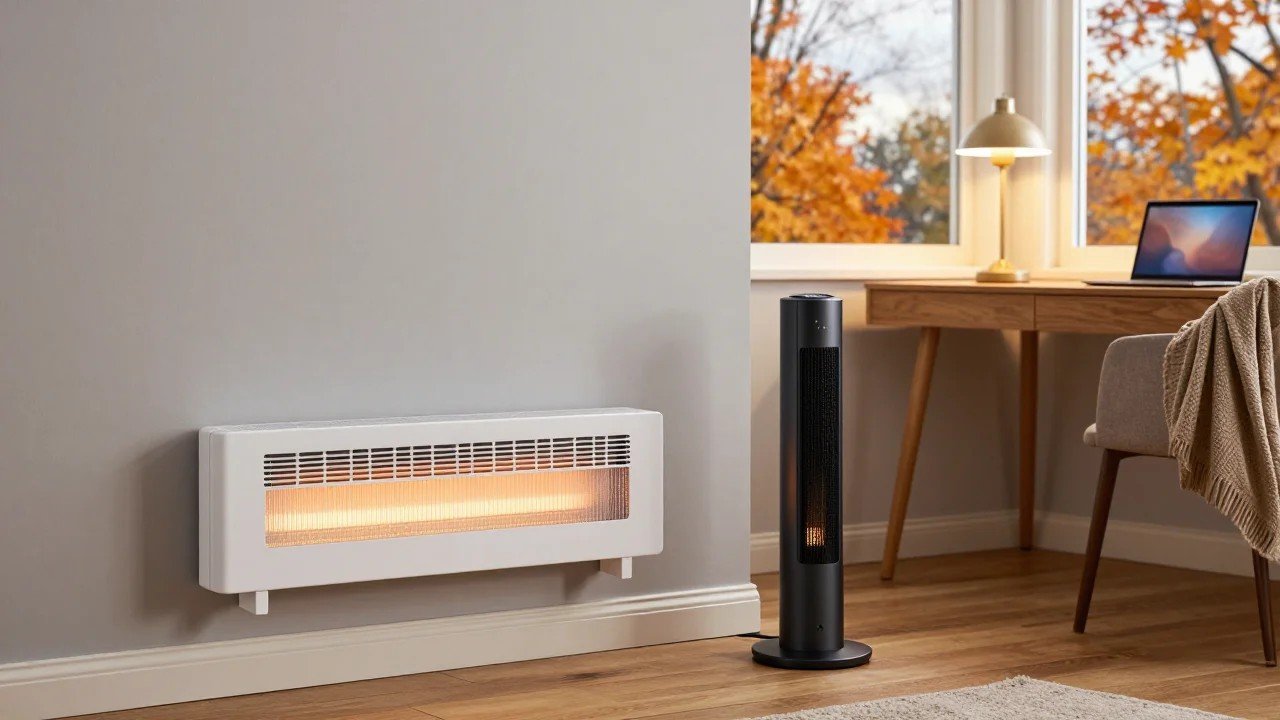
The WH719S is the heater that makes “smart” genuinely useful. It mounts on the wall like a mini-split head, so it’s out of reach of pets and kids and doesn’t eat floor space, and it can also sit on a stand if you rent. You set an exact temperature and it holds it in single-degree steps instead of blasting on and off. The Dreo app adds schedules, and it works with both Alexa and Google Assistant, so “Alexa, set the office heater to 70” just works. A 120° up-and-down oscillating louver spreads the warm air, and there’s a fan-only mode, which makes it useful in summer too.
Pros: off the floor, precise thermostat, quiet, schedules and voice control, works as a fan. Cons: sized for small to medium rooms; wall mounting means drilling.
Check the Dreo WH719S on Amazon
2. Vornado AVH10: best non-smart heater overall
Who it’s for: people who want even, quiet, whole-room heat and don’t care about apps.
Vornado heaters don’t just push hot air at you; they circulate it around the room, which is why the AVH10 shows up at the top of so many hands-on tests. Its automatic climate control picks the right output to hold your set temperature, it’s whisper-quiet, and it includes tip-over and overheat protection. The trade-offs are real but minor: there’s no timer and it doesn’t oscillate, because the vortex design is meant to move air throughout the room instead.
Pros: very even heat, quiet, accurate temperature control, strong safety features. Cons: no timer, no Wi-Fi, no oscillation.
Check the Vornado AVH10 on Amazon
3. Dreo Solaris Tower Heater 718: best for large rooms
Who it’s for: living rooms, finished basements, and drafty open-plan spaces.
Big rooms expose weak heaters fast. The Solaris 718 is a tower built to push heat across a larger space while staying quiet enough for movie night, and testers have praised its balance of power, low noise, and efficient operation. If you’re heating a basement den or a living room with high ceilings, start here.
Pros: strong output, quiet, efficient modes. Cons: bigger footprint than a compact heater; check the listing for which version includes app control.
Check the Dreo Solaris 718 on Amazon
4. Lasko AR122 Therma-Smart Tower: best smart heater on a budget
Who it’s for: shoppers who want app and voice control without paying wall-heater money.
The AR122 is an oscillating ceramic tower with Wi-Fi, so you can turn it on from bed or have it warm the room before you get home, and it works with Alexa and Google Assistant. Its smartest trick is occupancy sensing: it can tell when the room is empty and shut itself off, which saves energy and adds peace of mind if you’re the type to forget. The main complaint is that you rely on the app or the buttons, since it doesn’t ship with a physical remote.
Pros: affordable, Wi-Fi and voice control, auto-off when nobody’s there. Cons: no physical remote; less refined heat than a Vornado.
Check the Lasko AR122 on Amazon
5. Pelonis 30-Inch Smart Tower Heater: best portable smart tower
Who it’s for: renters and anyone who wants smart features in a heater they can move from room to room.
If you’d rather not drill into a wall, a tall oscillating tower is the next best thing. The Pelonis spreads heat well thanks to its height and oscillation, runs on app schedules, and responds to Alexa and Google Assistant. It’s a good fit for larger bedrooms and living areas up to roughly 300 square feet.
Pros: portable, tall for better spread, schedules and voice control. Cons: takes floor space; the app is more basic than Dreo’s.
Check the Pelonis smart tower on Amazon
6. Dreo Smart Wall Heater for Bathroom (517AS): best for bathrooms
Who it’s for: anyone who dreads stepping out of a warm shower into a cold bathroom.
Most space heaters should never go near water. The 517AS is designed for it: it’s splash resistant (rated IP24) and comes with a shock-protection plug that cuts power if it detects a current leak. It mounts on the wall, so it stays clear of puddles, and you can schedule it to pre-warm the bathroom before your morning shower using the app or Alexa.
Pros: built for damp rooms, shock-protection plug, wall-mounted, schedules. Cons: sized for bathrooms and small rooms; Alexa only for voice.
Check the Dreo 517AS on Amazon
7. Dreo Whole Room Heater: best coverage for odd-shaped rooms
Who it’s for: L-shaped rooms, lofts, and spaces where heat tends to pool in one corner.
Few heaters oscillate in two directions, and that’s what makes this one stand out: it can sweep side to side and tilt up and down at the same time, spreading warm air into corners a regular tower misses. It’s a smart pick if one end of your room always stays cold.
Pros: excellent coverage, dual-direction oscillation. Cons: more moving parts than a basic heater; smart features depend on the version you buy.
Check the Dreo Whole Room Heater on Amazon
8. Vornado MVH Vortex Heater: best budget pick
Who it’s for: a small bedroom, dorm, or office where you want reliable heat for little money.
The MVH is about as simple as heaters get: a few heat settings, a thermostat dial, and Vornado’s vortex circulation. It warms a surprisingly large space for its size, includes tip-over and overheat protection, and is the kind of heater that lasts for years.
Pros: inexpensive, proven design, compact. Cons: no digital display, no timer, no smart control.
Check the Vornado MVH on Amazon
How to choose the right space heater
Size it to the room
Almost every plug-in space heater sold in the US tops out at 1,500 watts, because that’s what a standard 120-volt household circuit can safely supply. A common rule of thumb is about 10 watts per square foot, so a 1,500-watt heater comfortably handles around 150 square feet as the main heat source, and more if it’s only topping up your central heat. Big, drafty, or high-ceiling rooms need a heater designed for circulation (like a vortex or tall tower), not just more watts.
Ceramic, vortex, oil-filled or infrared?
- Ceramic (fan-forced): heats up fast and is compact. Best for quick heat in bedrooms and offices. Most smart towers are ceramic.
- Vortex/circulating: uses a fan to move warm air throughout the room for more even temperatures. Best for whole-room comfort.
- Oil-filled radiator: silent and gentle, keeps radiating after it turns off, but slow to warm up. Best for overnight use in bedrooms.
- Infrared: warms people and objects directly rather than the air. Best for garages, patios (outdoor-rated models only), and drafty spaces.
Is a smart heater worth it?
Yes, if you’ll use the schedule. The real savings from a space heater come from heating only the room you’re in, and a smart heater makes that automatic: warm the office at 8 a.m., the bedroom at 10 p.m., and nothing while you’re out. Remote control also means you can check that it’s actually off after you leave. If you just want to switch it on when you’re cold, a good non-smart heater like the Vornado AVH10 is the better value. If you’re thinking about heating the whole house more efficiently, a smart thermostat is the bigger upgrade, and the two work well together.
Safety features that matter
- Tip-over switch that cuts power if the heater is knocked over
- Overheat protection that shuts it off if internal parts get too hot
- Safety certification from a recognized lab such as UL, ETL, or CSA
- Cool-touch housing if you have kids or pets
- Auto shut-off timer or occupancy sensing so it doesn’t run in an empty room
What does a space heater cost to run?
The math is simple: watts ÷ 1,000 × hours × your electricity rate. A 1,500-watt heater on full power uses 1.5 kWh per hour. At an example rate of 17 cents per kWh, that’s about 26 cents an hour, or roughly $2 for an eight-hour workday. Check your own utility bill for your rate, since it varies a lot by state. In practice, a heater with a thermostat cycles on and off once the room is warm, so real costs are usually lower, and eco modes cut them further. Heating one room this way is often cheaper than raising the thermostat for the entire house.
Space heater safety: the rules worth following
- Plug it directly into a wall outlet. Don’t use an extension cord or a power strip. Even a good surge protector power strip is meant for electronics, not a 1,500-watt heater.
- Keep three feet of clear space around it, away from curtains, bedding, furniture, and paper.
- Don’t run it unattended or while you sleep unless the manufacturer says the model is designed for it, and never leave kids or pets alone with it.
- Use only bathroom-rated heaters in bathrooms, like the Dreo 517AS, and keep any heater away from water.
- Have working smoke alarms on every level of your home and test them as the heating season starts.
FAQ: what people ask about space heaters
What is the safest space heater to leave on?
No space heater should be left running in an empty home. For long sessions in an occupied room, choose a model with tip-over and overheat protection, a recognized safety certification, and a thermostat, plus an auto-off timer or occupancy sensing like the Lasko AR122. Wall-mounted heaters such as the Dreo WH719S also remove the tip-over risk entirely.
Can I plug a space heater into a smart plug?
Generally, no. A space heater can draw up to 15 amps continuously, which is at or beyond the limit of most smart plugs, and many heater manuals specifically forbid using one. If you want app control and schedules, buy a heater with Wi-Fi built in. Save smart plugs for lamps, fans, and small appliances; our best smart plug guide explains what they handle well.
Do space heaters use a lot of electricity?
On full power, a typical heater uses 1.5 kWh per hour, similar to running a microwave continuously. Used to heat one room while the rest of the house stays cooler, it can lower your total heating bill. Used to heat a whole house, it’s usually more expensive than your furnace or heat pump.
Which type of space heater is most energy efficient?
All electric resistance heaters turn nearly 100% of their electricity into heat, so no type is dramatically more efficient. What saves energy is control: an accurate thermostat, eco modes, schedules, and heating only the room you’re using. That’s where smart heaters earn their price.
Is an oil-filled heater better than a ceramic heater?
It depends on the job. Oil-filled radiators are silent and give steady, gentle heat that’s great for bedrooms, but they’re slow to warm up and heavy. Ceramic heaters warm you up within seconds and are easy to move, which suits offices and short sessions.
What size space heater do I need?
Use about 10 watts per square foot as a starting point. A 1,500-watt heater suits a room of roughly 150 square feet as the primary heat source. For bigger or draftier rooms, look for a heater designed for whole-room circulation, or use two heaters on separate circuits.
Do smart space heaters work with Alexa and Google Home?
Most do, but check the listing. The Dreo WH719S, Lasko AR122, and Pelonis smart tower work with both Alexa and Google Assistant, while the Dreo 517AS bathroom heater supports Alexa. Apple Home support is still rare among space heaters.
The bottom line
If you want the best all-around smart heater, get the Dreo Smart Wall Heater WH719S: it’s off the floor, holds your temperature precisely, and runs on schedules and voice commands. If you don’t need Wi-Fi, the Vornado AVH10 delivers the most even, quiet heat. Big rooms call for the Dreo Solaris 718, budget smart shoppers should look at the Lasko AR122, and bathrooms deserve the purpose-built Dreo 517AS. Whichever you choose, plug it straight into the wall, give it room to breathe, and let the schedule do the work. Prices shift quickly as the weather turns, so check current prices on Amazon before you buy.